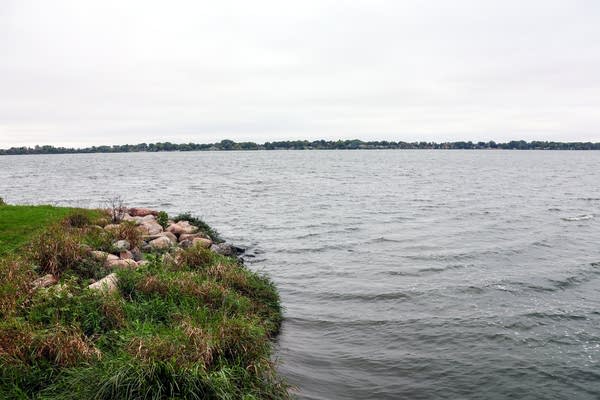
What should be a serene oasis in the middle of the city of Worthington, instead is too often a stinky, unsightly pool of murky water. Lake Okabena, a shallow 776-acre body of water, has a persistent problem—algal blooms, and despite several local projects and efforts to improve its water quality, healing the water continues to be a work in progress.
The lake turns scuzzy with green, goopy algae as high levels of phosphorus and nitrates run into the waters from nearby farmland. When the conditions are right, like during the summer’s frequent heat waves, it can look like pea soup.

And each time that happens, the waters emit a foul odor, said Kiara Castaneda, 24, a Worthington resident, describing it “like a dead fish smell.”
“It’s hard to get in the water and to enjoy it because a lot of people go boating here, myself included,” Castaneda said. “And you can smell the lake from a distance, like when there’s strong wind gusts, you can smell it for sure.”
That’s disappointing for local residents who love using Lake Okabena for recreational activities like fishing, boating, swimming and even windsurfing. For Marilyn Cilengi, 27, of Worthington, she said the beauty of the lake goes under appreciated because of its persistent problems, which hurts Worthington.
“Definitely could be appreciated more, romanticized more,” Cilengi said. “It’s beautiful, I like that people take laps around it. I hope to see more people swim in it, but I’ve noticed over the years, less and less people swimming in it, and as that decreased, I noticed the increase in the smell. It’s a very bad smell that comes from the lake and doesn’t look the greatest either.”

Lake Okabena was assessed back in 2009 by the Minnesota Pollution Control Agency, and “it was determined that the water quality was not meeting our standards for recreation, and that primarily means that that the total phosphorus in the lake was too high,” according to Scott MacLean, MPCA’s watershed supervisor for southwest Minnesota.
In 2022, the MPCA conducted another assessment and still saw impairment, though water clarity improved slightly.
But during heavy rains, soil, nutrients and pollutants still end up getting flushed into the lake from within the city itself, and from the thousands of acres of farmland in Okabena’s watershed. Invasive aquatic species like curly-leaf pond weed also contribute to the amount of nutrients released into the water, and abundant bottom-feeding rough fish like common carp, also stir up sediment, clouding up the water even more.
Where do things stand?
The lake’s condition hasn’t gotten much better since that 2022 assessment, said Nathan Schuck, administrator for the Okabena-Ocheda Watershed District. While water clarity has incrementally improved, there are still excessive levels of phosphorus and nitrates that continue to be present in the lake.
But in recent years, local and state agencies and Worthington residents have ramped up efforts to clean up Lake Okabena, reduce harmful runoff and minimize the impact of elevated phosphorus and nitrates.
Those efforts include the Prairie View Project, which took the former Prairie View municipal golf course next to Lake Okabena, and transformed it into a water quality improvement site. It was designed to catch, store and filter stormwater runoff before it enters the lake, reducing the amount of phosphorus and silt going into it.
And several years ago, the Okabena-Ocheda Watershed District placed man-made floating islands—also known as biohavens—in Sunset Bay on Lake Okabena to help support water quality and habitat health. Those little islands act as natural filters that absorb phosphorus and nitrogen and also curb algae growth on the water.

Another plan currently under discussion is the Crailsheim Project, which would reroute the way a creek meanders and flows into the lake, reducing the amount of phosphorus it pours into Lake Okabena. There have also been discussions about using aluminum buoys that use sensors to collect data on algae growth and would then emit ultrasonic radio frequencies to prevent algae from rising to the surface.
“There is no one silver bullet that’s going to fix the problems in the lake,” Schuck said. “It’s going to be multiple projects over, I don’t want to call it a long period of time, but it’s definitely not going to be just a couple years.”

But these mitigation efforts do have an impact, said Scott MacLean of the MPCA.
MacLean said he’s optimistic about the long-term health of Lake Okabena. He points to Lake Shaokatan in Lincoln County, about 90 miles north of Worthington, which had a decades-long problem with high phosphorus and nitrate levels. But, MacLean said, after about 20 years time, residents’ efforts helped restore it.
The hope is that the same water quality improvements can be made in Lake Okabena.
“Change is going to take a while,” MacLean said. “It took a while to get these lakes to the point they’re at, and so it’s going to take a while before we see some of those improvements. There’s a lot of great work being done out there, both out in the rural area and in the city. So, I’m confident that we will see improvement. It’s just something that takes some time.”
Special thanks to Danger Boat Productions and the Minnesota Humanities Center for their Sketches of Minnesota events around the state that helped inform this report.
Collected from Minnesota Public Radio News. View original source here.
 Minnesota Public Radio (MPR) is a public radio network for the US state of Minnesota. With its three services, MPR News, YourClassical MPR and The Current, MPR operates a 46-station regional radio network in the upper Midwest.
Last updated from