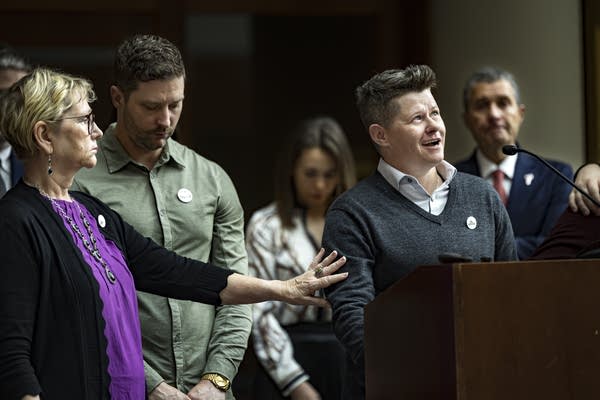
Lawyers for the family of Renee Good on Thursday invoked an 1871 law meant to fight the terror of the Ku Klux Klan as they filed two civil lawsuits seeking accountability for Good’s killing by a federal agent during Operation Metro Surge.
The lawsuits name Jonathan Ross — the Immigration and Customs Enforcement agent who fatally shot Good — as well as current and former Trump administration officials, including Gregory Bovino, Kristi Noem, Tom Homan and Stephen Miller.
“The day of accountability has arrived for our own U.S. government and its governmental agencies,” attorney Antonio Romanucci told reporters Thursday as he stood beside Good’s family after filing the lawsuits. “Our government is killing our citizens without any legal justification.”

The lawsuits seek accountability for the decisions of public officials and federal agents as well as damages “for the immense suffering Renee endured in the final moments of her life and for the profound and permanent losses” suffered by her family.
“She was the love of my life,” Becca Good, Renee’s partner, told reporters Thursday in her first public remarks since witnessing Renee’s killing. “She was funny and she was smart and she was gorgeous. She was the center of my universe. You don’t know how much light someone gives you until it’s gone.”
A ‘campaign to terrorize’
Renee Good was shot and killed inside her vehicle on the morning of Jan. 7 in south Minneapolis, near East 34th Street and Portland Avenue.
Federal authorities quickly called the shooting justified, saying 37-year-old Good tried to run down ICE agents with her vehicle and that the agent — later identified as Ross — fired to protect his life and the lives of other officers.
Bystander video, however, contradicted that narrative. Eyewitnesses said agents gave Good conflicting orders about whether to stay or go, and that she appeared to just want to leave the scene.

Ross, the ICE agent who fatally shot Good, was one of thousands of federal immigration agents that flooded the Twin Cites over the winter in Operation Metro Surge. Federal officials said they were searching to find and deport the “worst of the worst,” but that’s not what happened.
Data later showed that fewer than one-quarter of those arrested had a criminal conviction on their record. A little more than 13 percent of those arrested had pending criminal charges.
The White House used “unfounded and exaggerated accusations” about fraud in Minnesota to send masked agents into Minneapolis neighborhoods to “harass people based on how they looked” and led those agents to believe they wouldn’t face consequences for their actions, said attorney Benjamin Berkman.
The second of the two civil suits invokes the Ku Klux Klan act of 1871.
Congress passed that law at the time “because masked men were going in disguise on the highway to terrorize their neighbors on account of their race,” Berkman said. One hundred fifty-five years later, armed men went in disguise on Portland Avenue. They went as part of campaign to terrorize people based on the way they looked — and now Renee Good is dead.”
Using the anti-Ku Klux Klan law, he added, “reaches the agent who fired those shots and every public official who put him on the street that day.”
Messages left with the Department of Justice and Department of Homeland Security, seeking response to the lawsuits, were not immediately returned.
Vigils for Renee Good popped up across Minnesota hours after she was killed, as the state found itself at the center of a national debate on immigration enforcement.
Two and a half weeks later, federal agents in Minneapolis shot and killed 37-year-old Alex Pretti on Jan. 24 near 26th Street and Nicollet Avenue.
The Department of Homeland Security said in a statement that Pretti was armed with a handgun, that a struggle ensued as agents tried to subdue him and that an agent “fired defensive shots.” But video and eyewitness testimony again disputed federal officials’ account.
Collected from Minnesota Public Radio News. View original source here.
 Minnesota Public Radio (MPR) is a public radio network for the US state of Minnesota. With its three services, MPR News, YourClassical MPR and The Current, MPR operates a 46-station regional radio network in the upper Midwest.
Last updated from
Minnesota Public Radio (MPR) is a public radio network for the US state of Minnesota. With its three services, MPR News, YourClassical MPR and The Current, MPR operates a 46-station regional radio network in the upper Midwest.
Last updated from