The first hint that I needn’t be so anxious to interview Min Jin Lee came as the bestselling author descended the creaky stairs of her five-story Harlem townhouse and pronounced my name. Not in the way my brain has articulated it for decades, smoothed over by an anglicized version that made it easy for teachers to call out from an attendance roll. Which is to say, Lee, on a Friday afternoon in August, pronounced my name the way the people who brought me into this world had intended.
The next came when Lee, smartly dressed in a gray vest and jeans, with a pair of delicate drop earrings, doled out lively profanities. She was recalling her time attending Students for Fair Admissions v. Harvard, the landmark case that would later reach the Supreme Court and dismantle race-based affirmative action, as part of her nearly decade-long research process for American Hagwon, the much-anticipated third installment of a planned quartet dedicated to Korean diasporas. As a supporter of affirmative action, she witnessed testimony teeming with stereotypical portrayals of Asian American students, including, as Lee puts it, making them out to be like “machines.”
“I sat there in the press box, and I remember thinking, this whole idea that Asian Americans have shitty personalities—that’s really shitty. It’s a really shitty thing to say.”
“Also, we’re talking about children,” she continued, her voice intensifying. “How dare you insult the children of my community?”
To hear Lee condemn the racial stereotyping of Asian Americans, including the “stupid, horrible racial epithet called ‘tiger parenting,’” with such blunt rigor, in a living room sumptuously bedecked with books, was deeply satisfying. My own fondness for profanity, my Korean-born mother used to warn, was a sign “of an uneducated person.”
“I think your mom was right,” Lee said, warmly laughing as I shared the memory with her.
American Hagwon is Lee’s third novel and follows Pachinko, the vast 2017 saga that traces four generations of a Korean family as they weather war, discrimination, and cruelty in Japanese-occupied Korea and in Japan. A finalist for the National Book Award, Pachinko established Lee as a master of sweeping historical narrative. American Hagwon, on the other hand, takes place in more contemporary times, with Lee’s aperture shifting between a multigenerational family drama and broader meditations on the human costs of heedless ambition.
What are the human costs of endless ambition? Would we choose differently if we were liberated from the pursuit of educational status?
“I asked myself, if I had one more book to write, I wanted to write about what’s most important to Koreans around the world, and it was so clear to me that it was education,” Lee said. “It’s not money. It’s not religion. It’s not status. It’s actually education. This kind of faith in it, even if you hated it.”
As its title telegraphs, the Korean for-profit tutoring academies known as hagwons provide a motif in Lee’s latest novel. Hagwons typically offer classes from elementary school all the way through high school, but it is the courses aimed at boosting test scores for college entrance exams that they are best known for. (If you’re imagining a Korean equivalent to a Kaplan prep, think bigger; in South Korea, hagwons are a multibillion-dollar industry that one of the country’s leading English-language newspapers once described as “thriving on anxiety.”) To outsiders, they can conform to a long-standing stereotype of Asian students: relentlessly driven, much to their own personal misery, with cutthroat parents digging into their bank accounts to further their children’s competitive advantage.
The criticism hagwons attract can be well earned; fierce competition, at times bordering on toxic, is often central to the hagwon mentality. But for Lee, sensationalistic portrayals of them risk reinforcing simplistic racist tropes. For kids in the United States, hagwons are also often places of community, one of the few spaces, in a white world, to connect with other kids of Korean descent. They can also function as de facto daycare centers, she said, where parents can have their kids picked up from school, safely driven to the hagwon, and “given a juice box, pretzel rod, and worksheets” instead of having a child “stay at home and have a shelf fall on them.” In a country lacking adequate childcare, Lee sees hagwons as “an ethnic solution to a state problem.”
American Hagwon arrives amid a wider reckoning over the value of a top-tier education, particularly in the United States, as the yearly total cost of some colleges surpasses $100,000 and AI threatens the very foundations of what it means to hold knowledge. There’s an “anxiety that the modern person feels right now,” Lee said, referring to the existential questions born out of AI.
A similar anxiety courses through American Hagwon, as multiple families of Korean ethnicity, compelled as so many émigrés are by the desire to secure better futures for their children, are upended by unexpected outside forces, including the 1997 Asian financial crisis.
When we first encounter the novel’s central family, the Kohs, John and Helen appear to be typical middle-class parents who had just moved to Seoul from Sydney, Australia, dutifully attentive to their three children’s education, while John toils away as a manager at a large corporation. But when he endures a devastating betrayal, both professionally and personally, it forces the family to emigrate, eventually landing in Southern California. Throughout the sacrifices that follow—John takes up a physically demanding job at a fish-fry restaurant; Mido, the youngest and only daughter, pauses her college education and works at an American hagwon to support her family, including her brothers’ education—the thread of familial devotion grows only stronger.
It is through this lens of empathy, paired with prolific research, that Lee shows us how hagwons reflect the deep-rooted desires of a culture fixated on upward mobility and one that has long identified education as the ticket to a vertical trajectory. As one mother in American Hagwon notes: “The cost doesn’t matter. We all know you have to pay up for the best coaching.” Still, such a narrow view of success inflicts its own damage, raising some of the deeper questions in the novel: What are the human costs of endless ambition? Would we choose differently if we were liberated from the pursuit of educational status?
The middle child of three sisters who emigrated with their parents from Seoul to the Elmhurst neighborhood of Queens, New York, when she was 7, Lee did not attend a hagwon. But she wrestled with such questions during the brief period she worked as a corporate lawyer after Georgetown Law, its own kind of pressure cooker. “The more work I would do, the more work I would be given,” she recalled. “Capitalism, right? Because I am not getting paid more. The more hours that I bill, the more the firm makes.”
“I was really thinking,” she told me, “I don’t want to die working this way.”
So Lee, who was diagnosed with a serious liver disease in high school, quit law to pursue a full-time career in writing, publishing her first novel, Free Food for Millionaires, in 2007.
Were her parents—Korean immigrants who owned a wholesale jewelry store in midtown Manhattan—ever disappointed by her decision to quit law to pursue something as impractical as a career as a novelist? I wondered. “My parents aren’t pushy,” Lee replied. She stressed, however, that the support for the literary ventures she now enjoys did not always come easily. On the same day Pachinko was published, her husband lost his job in finance.
What followed is a familiar middle-class story, a moment of great upheaval not unlike the devastating twists that upend the families of American Hagwon. Lee, who was 48 at the time, and her husband struggled to obtain healthcare and navigate the administrative hellhole of COBRA; her efforts to find a job in teaching were regularly dashed. “Absolutely nobody would give me interviews,” Lee said. “It didn’t matter that I had two published novels. So what? So does everybody else. Some people were very unkind. Truly, it kind of struck me how cruel younger people could be to somebody older.”
In a gentler world, locking eyes with a life-threatening disease would not be the only way to clarify how we want to live. But Lee’s decision to quit law cuts to the animating tension that roils throughout American Hagwon: What constitutes a meaningful life? Toward the end of the novel, Mido and her hagwon colleagues ask their students’ parents: What does an impressive résumé, all that schooling, and a lucrative career amount to if you’re miserable?
“Our children cannot know everything,” Lion, one of the hagwon’s co-owners, tells the parents during a lecture he organizes about the value and pressures of education: “This flawed but worthy American project of immigration, reinvention, and multiple chances creates more possibilities, but it requires us to explore different paths in order to have lives of greater purpose.” Any sense of “failure” that creeps in when kids don’t get into their top-choice school, Lion continued, is “a terrible way to start their higher-educational experience, and adulthood.”
“The inability to live with your truthful self determines the tragedy of your own life.”
“The inability to live with your truthful self determines the tragedy of your own life,” Lee said. “What I really saw when I was doing the research is that the people who are doing the best were not necessarily the wealthiest or the most elite; they’re the ones who actually had love in their lives.” The Kohs, despite having lost so much, are clearly animated by such love.
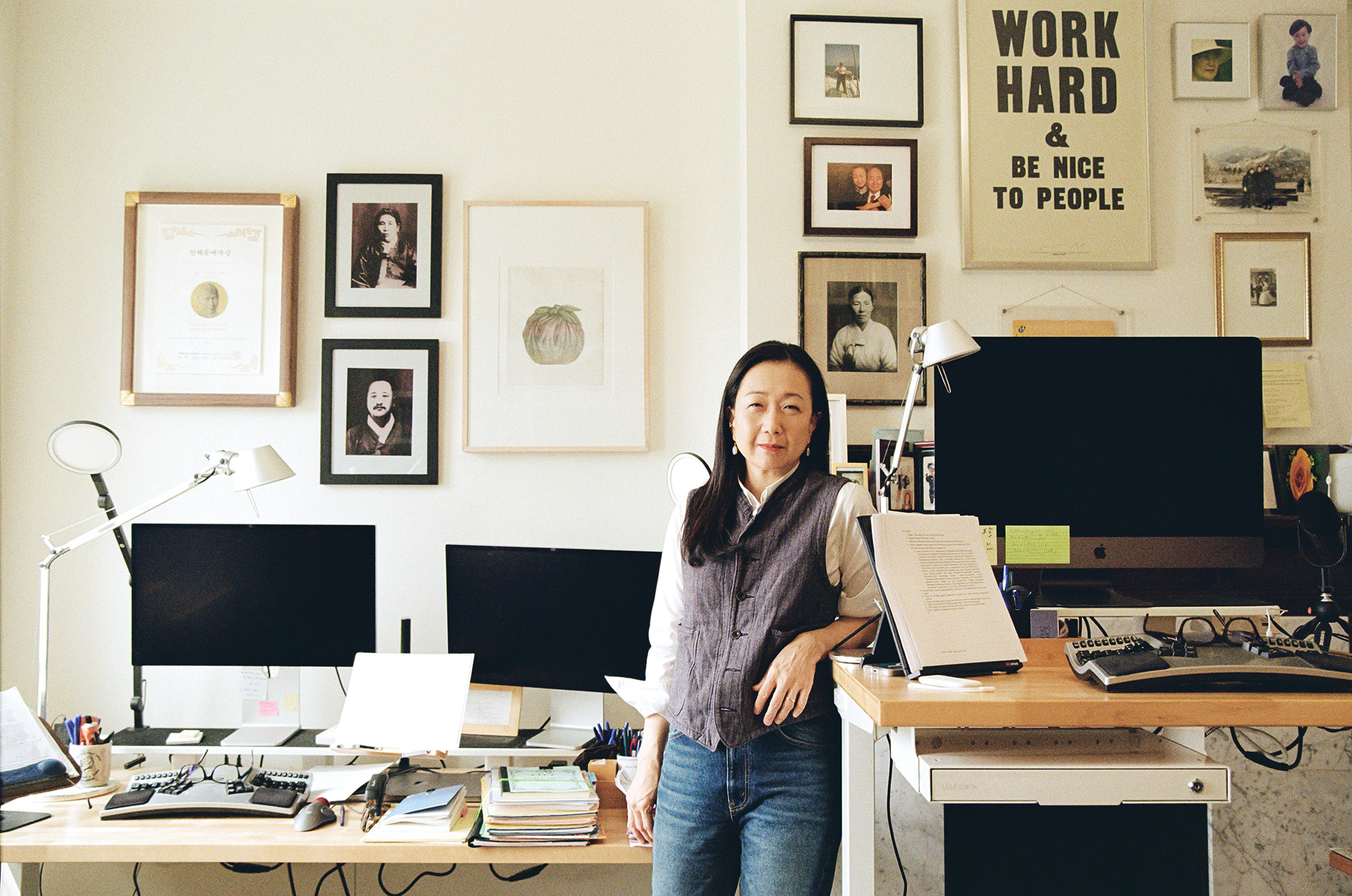
After we spoke for about an hour, we climbed the creaky stairs and reached Lee’s office on the third floor of the townhouse, where, surrounded by family photos, she offered snacks. First, a pack of black garlic almonds, and then Kopiko, an Indonesian coffee-flavored hard candy that she noted is ubiquitous in K-dramas—even though it’s not Korean.
I wasn’t familiar with either and accepted both. As I left her Harlem home, I couldn’t help but walk faster, excited to share the Kopiko with my mom. After all, it was her sacrifice and hers alone that afforded me my own time at a hagwon in Edison, New Jersey, while she picked up shifts at a nearby dry cleaner. I’ll always have a sense of uneasiness about that time. But at that moment, picking up the pace as I headed down to the subway clutching coffee candies, I felt only gratitude.
 Mother Jones is a nonprofit American progressive magazine that focuses on news, commentary, and investigative journalism on topics including politics, environment, human rights, health, healthcare and culture. Clara Jeffery serves as editor-in-chief of the magazine. Monika Bauerlein has been the CEO since 2015.
Last updated from
Mother Jones is a nonprofit American progressive magazine that focuses on news, commentary, and investigative journalism on topics including politics, environment, human rights, health, healthcare and culture. Clara Jeffery serves as editor-in-chief of the magazine. Monika Bauerlein has been the CEO since 2015.
Last updated from