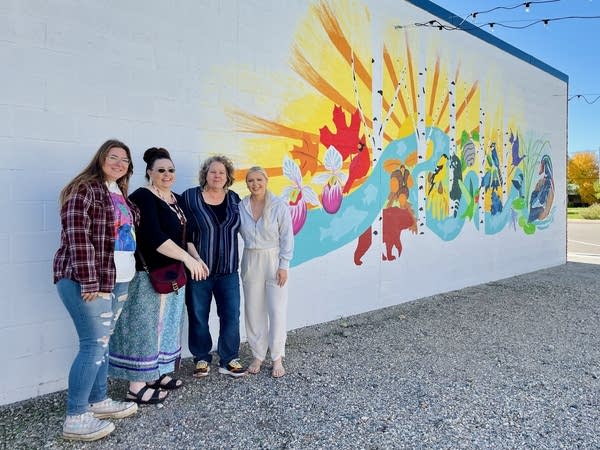
Weave through Mahnomen, a city of about 1,300 people on the White Earth Reservation in northwestern Minnesota, and it’s clear that artists have been at work.
On the lawn of city hall, itself a handsome fieldstone building from 1937, is a canoe sculpture painted with a sunset over a lake in the signature hypercolor of Kent Estey, a White Earth artist. About 10 of these art canoes by different local artists punctuate the streets with color.
Embedded in a nearby sidewalk is a poem by a local student: “Spring, no shoes, no socks, just feet.”
This kind of poetry underfoot is all around town, including a block north at the Mural Arts and Eats lot, an open plot between buildings laid with fresh concrete and green turf, set with picnic tables and string lights. Here are colorful murals on opposite walls — one features a river weaving through birch trees, wild rice, a loon, lady’s slipper flowers and other flora and fauna; the other says “Mahnomen,” with a crescent moon and medicinal plants.

“People in Mahnomen are seeing art now — which, five years ago, there wasn't really any in town,” Estey said. “They're seeing examples of art and what that can do for a small community.”
All this public art comes from projects by the Manoomin Arts Initiative.
“We are the only artist-led initiative in the White Earth Nation,” said MAI Executive Director Joseph Allen, adding that MAI is one of the few Native-led groups of its kind in the region.
Allen described the initiative as a unique nonprofit in a unique place: Mahnomen is the largest city on the reservation with a population that is 50 percent Native and 50 percent white. Mahnomen takes its name from manoomin, the Ojibwe word for wild rice.

These public art projects are just the beginning, Allen says. Another project debuts Nov. 12 at the open house for the MAHUBE-OTWA Community Action Partnership, a nonprofit that provides services for low-income and older adults. It takes its name from the counties it serves (Mahnomen, Hubbard, Becker, Otter Tail and Wadena).
MAHUBE-OTWA contracted MAI to create an arts billboard on the exterior of the building, which used to belong to the American Legion, as well art on the interior by local artists, much of which will be for sale.
“It's a huge project,” said Rebecca Dallinger, MAI programming and operations director and Allen’s wife. “To have nonprofit organizations within our communities want to invest essentially in Manoomin Arts.”
Phase one
The new public art project is a block east of the MAI’s first, the “Mahnomen” mural. On an early autumn day, artist Penny Kagigebi points to the strawberry, or ode'imin (Ojibwe for “heartberry"), on the “Mahnomen” mural.

“The strawberry is the first plant that grew here when we came here from the stars and we were placed here in North America,” said Kagigebi, a descendant of the White Earth Nation and a founding member of MAI. “That strawberry is a symbol of life.”
In 2022, Kagigebi and Estey painted the mural with local teens from surrounding schools and White Earth 4-H, as well as a visiting artist from New York, Matt Litwack. The river mural was painted in 2023, and this past spring the concrete and turf was added.
“Now it's a beautiful gathering space, but before it was kind of a hazard because there were wasps that were always coming up out of the ground,” Kagigebi said.
A few years back, the lot was occupied by a dilapidated garage before the city tore it down, said Taylor Vonderharr, the city administrator for Mahnomen, who is also at the mural lot. Vonderharr says it’s now a popular lunch spot with visiting food trucks.
“Phase one of revitalizing Mahnomen is to add important pieces like this that the Initiative does all over town,” said Vonderharr, who is on the MAI board. Before MAI, there were some efforts to beautify the town with art, “but nothing like it is now.”

‘The biggest need is space’
A few blocks south of the murals and city hall, near Shooting Star Casino, MAI’s executive director Joseph Allen walks around a building that once belonged to Starkey’s Photography. As of October, MAI transitioned from renters to owners of the building. In the lobby is photography by Allen and other artists; Allen’s large portrait of Annie Humphrey, an Ojibwe artist and activist, greets visitors.
As a founding MAI member, Allen said their mission has been to develop an artist network, mentor emerging artists and create spaces dedicated to art, a scarce resource in the area. Allen is an enrolled member of the Rosebud Lakota tribe from South Dakota and a descendant of the White Earth Nation. He spent years living and working as a photographer around the country and Minneapolis. In 2009, he and Dallinger moved to the area to raise their daughters near nature.
“It took me longer to get connected to the community here,” Allen said.

“The biggest [need] is space, and so space to create, space to teach and learn,” said Allen, who points to the local housing shortage. “Native artists have a hard time finding spaces in rural areas.”
Also at the new MAI building are Dallinger and MAI board secretary Eliza Klarer.
“A lot of us artists, we have to work out of our bedrooms or at the kitchen table,” said Klarer, a White Earth artist who studied painting and ceramics at University of Minnesota-Morris. “It's more fun for me to create alongside other people because we can share ideas and that's part of what I miss about working in the studios in college.”
Art studio spaces are critical in places like Mahnomen, Dallinger says, because artists need a place to keep their materials and work on their craft or a project over time.
“There are these other wonderful spaces in White Earth,” Dallinger said, but "you can't leave things because there's something else happening the next day.” She added, “To have something that's just arts-based only, that your stuff can stay there and you just keep working on it — that's the kind of thing we're really needing to do even more of.”

Allen said the newly acquired building will continue to operate as a photo studio for local photographers, but they will also build out a residency and artist apartment program, which Allen says will be similar to the programs at YES! House in Granite Falls in southwestern Minnesota and the rural headquarters of Springboard for the Arts in Fergus Falls.
MAI grew out of Allen's work collaborating with the city and the Mahnomen Economic Development Authority, which began when he was director of the Gizhiigin Arts Incubator housed in a building with a gallery, shop and studio right across Highway 59 from MAI’s new space. MAI was established as a nonprofit in 2025 and now stewards Gizhiigin, which helps artists living on the White Earth Reservation with professional development.
Rick Kagigebi is a local ceremonial blanket artist of the Lac Courte Oreilles Band of Ojibwe, and the husband of Penny, and he’s often uses the Gizhiigin space to work on his blankets as well as teach others the craft. Because it is a large art form, space is vital.
“I can't do it at home,” said Rick Kagigebi, standing in front of one of his blankets that stretches over a long table. Allen said Rick Kagigebi taught a popular ceremonial blanket-making class there.
“We have people driving two to three hours to get here from the region to learn from Rick,” Allen said.
A mighty network
These artist spaces create a destination and help build a network that connects artists to opportunities and the community to artists.
“Our network of people reaches so far throughout Minnesota,” Dallinger said.
She ticks off a list of connections: Penny Kagigebi is also a curator who’s worked with the Minnesota Museum of American Art in St. Paul for the 2025-26 exhibition “Queering Indigeneity," and is working on an upcoming show at the Minnesota Marine Art Museum in Winona. Kent Estey, who was the founding MAI board chair, has an exhibition at Ortenstone Gardens & Sculpture Park, run by the nearby Detroit Lakes nonprofit Project 412, as well as work on view in the inaugural show of the new Sovereign Studio art gallery in Fargo. Penny and Rick Kagigebi also have art on view — a quill box and ceremonial blanket respectively — at Sovereign Studio, and Rick and Eliza Klarer, whom he mentored in blanket-making, recently wrapped a show at the MacRostie Art Center in Grand Rapids.

“We're not just these individualistic, tiny, siloed groups, but we are expansive,” Dallinger said. “We may be a small group, but we are mighty.”
This kind of network led to a curating and consulting contract with MAHUBE-OTWA. Executive director Liz Kuoppala said that MAI has helped guide everything from the interior architecture and wall color to the design of the community spaces inside, including arts storage. Through MAI, the community nonprofit has purchased art from White Earth artists to display inside, and they will exhibit more artwork that visitors can purchase too.
“It’s a win-win solution,” Kuoppala said. “When someone can see art that was made by themselves or their cousin or their auntie, they will interact with that art a little bit differently than if it's something we bought that was mass produced and nobody has any kind of connection to it.”

Kuoppala said MAHUBE-OTWA will put up two more art billboards on the exterior walls and continue to curate the space with the help of Klarer and Dallinger.
“It's obvious when you go through Manomin that someone is paying attention,” Kuoppala said. “They’re movers and shakers, those Manoomin Arts Initiative people.”
The MAHUBE-OTWA open house featuring MAI art and artists runs noon to 2 p.m. Thursday, Nov. 12. On Nov. 13, MAI will host an event for Anishinaabe musician Doyle Turner’s new album at the Gizhiigin Arts Incubator.
Collected from Minnesota Public Radio News. View original source here.
 Minnesota Public Radio (MPR) is a public radio network for the US state of Minnesota. With its three services, MPR News, YourClassical MPR and The Current, MPR operates a 46-station regional radio network in the upper Midwest.
Last updated from