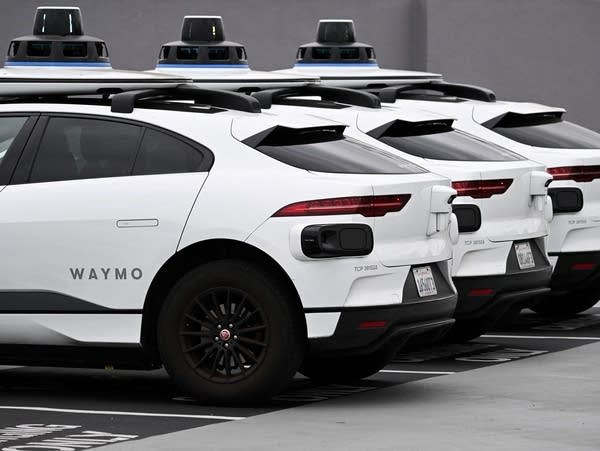
The St. Paul City Council has joined Minneapolis in the push for regulating driverless rideshare vehicles, like Waymo and Tesla Robotaxi, but with a different approach.
The council adopted a resolution Wednesday directing the city’s planning commission to study autonomous vehicles and suggest potential guardrails around safety, data-sharing and worker protections.
It’s a different path than in Minneapolis, where seven out of 13 council members voted for an ordinance requiring human safety monitors in driverless rideshare vehicles. Mayor Jacob Frey vetoed that ordinance, but it’s up for an override vote Thursday.
In St. Paul, council president Rebecca Noecker, who introduced the resolution, said human safety monitors could be a potential answer but it’s too early to say.
“Depending on what our recommendations are, depending on what our community tells us, there may be guardrails that we can put in place that allow for these vehicles to operate safely,” Noecker said. “But we need to do the work first to figure out if that's even possible."
She noted that St. Paul has more “breathing room,” rather than needing to write regulations “at the moment when a company is looking to come in.” But she said it’s imperative the city explores guardrails now, before Waymo is “literally at our door.”
Waymo, which currently operates a fleet of driverless vehicles in 15 cities, has been testing vehicles across Minneapolis for almost a year amid an absence of clear state laws surrounding their use. Though some residents, including council member Hwa Jeong Kim, said they’ve been spotted in St. Paul, too.
Kim said standing with immigrant neighbors — who make up over half of the state’s rideshare drivers — includes standing up to big tech.
”Do we ensure thousands of workers and drivers can afford to put food on their table and support their families,” Kim asked, “Or are we siding with billionaire tech CEOs who think they can ignore our regulations and undercut workers to pad their pockets?”
Kim pointed to a recent study that estimated rideshare drivers generate $561 million in economic output statewide and $43 million in local and state taxes.
Proponents of autonomous vehicles say they would prevent drivers from discriminating against disabled riders, give consumers more options, and point to some studies that indicate autonomous cars are safer than vehicles with drivers.
The resolution in St. Paul asks the planning commission to gather input from stakeholders, including disability advocates and rideshare drivers, before making recommendations.
Abdikani Ali, a community member who spoke at a press conference Wednesday, said he depends on driving to make a living.
“I drive people to work, to medical appointments, to the airport and around the neighborhoods, and the money I earn from that works right back into our community,” he said. “My family spends their money here. I support the local business here.”
Ali said he is opposed to profits going back to big tech CEOs, instead of into the community.
”Technology should not mean that the local workers lost their livelihood,” he said.
Collected from Minnesota Public Radio News. View original source here.
 Minnesota Public Radio (MPR) is a public radio network for the US state of Minnesota. With its three services, MPR News, YourClassical MPR and The Current, MPR operates a 46-station regional radio network in the upper Midwest.
Last updated from