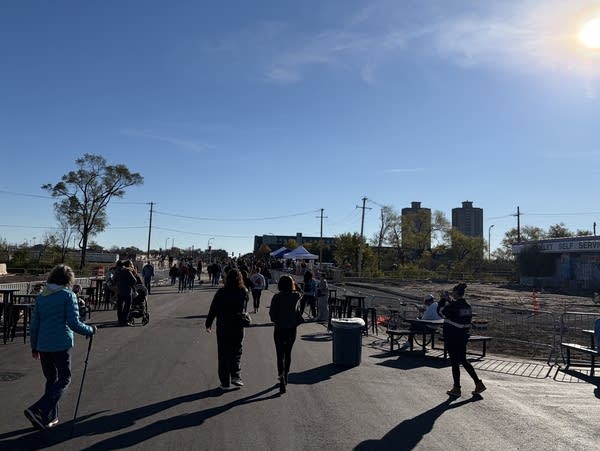
Neighborhood groups in south Minneapolis threw an outdoor party Sunday to celebrate the long-awaited reopening of Nicollet Avenue near Lake Street.
Around 100 people strolled back and forth across the bridge over the Midtown Greenway bike and pedestrian path to the site of the former derelict Kmart that divided Nicollet. The reopening will make an unbroken path from downtown Minneapolis to Bloomington and close a tear in a street people in the area say is vital to the cultural fabric of the city.
Barring last-minute construction or weather delays, Minneapolis plans to officially reopen the street to traffic on Nov. 24 for the first time since the city plopped the Kmart and parking lot on the site nearly 50 years ago.
Nicollet is nicknamed Eat Street in a nod to the many local restaurants that line its sidewalks, offering cuisines from all over the world. Its reopening comes toward the end of a year that was hard on many in the neighborhood.

The escalation of federal immigration activity this past winter left some businesses short-staffed, employees afraid to go to work and customers avoiding going out. Then came the morning of Jan. 24, when Border Patrol agents killed Alex Pretti on a busy corner of Nicollet, with police later filling the neighborhood with tear gas as protesters flooded the scene.
Music blared from the patio of Eat Street Crossing, a food hall near the street closure.
While traffic won’t officially reopen for two weeks, that is an instant compared to five decades. Generations of city leaders have described the Kmart-shaped hole in Nicollet as a well-intentioned mistake.
Kmart to Minneapolis: Put up a parking lot
Pat Berg’s last drive down Nicollet Avenue to Lake Street was a momentous one.
“I brought her home from the hospital across this street, probably one of the last ones to go across the street before they closed it off,” Berg said, recounting the day her daughter, Molly, was born.
Berg was opposed to the street’s closure, but city officials had other ideas.
In the 1970s, Minneapolis leaders wanted to create something like the bustling shopping malls of the growing suburbs, according to urban geographer and columnist Bill Lindeke. Planners razed the buildings in the area to make way for their vision: indoor shopping, a bowling alley, a health club and a movie theater.
“I think city leaders are much less likely to tear down a lot of historic buildings all at once than they used to be,” Lindeke said. “A lot of these buildings were not seen as having much value but actually fit the model of what people think cities should look like today.”
The city borrowed $8 million for the redevelopment project — about $46 million adjusted for inflation — and planned to pay that back with revenue from development. Those plans began falling apart when they couldn’t find developers willing to bite.
Until Kmart.

The big-box retailer, which at the time had nearly 1,500 stores in the U.S. and Canada, made Minneapolis an offer: it would move in if the city blocked off the street to make room for a store and large parking lot. The council approved the deal, despite pushback from a group called Keep Nicollet Open.
Still, the plan had its supporters. Even Berg was happy to have a Kmart and shopped there.
But by the late 1980s, city leaders were taking small steps to reverse course. They formed a task force to study reopening the street.
Minneapolis began buying back parts of the site in the 2010s, but it took until 2020 to buy out Kmart’s lease, which would have lasted until 2053. The store closed that year.
It temporarily hosted the U.S. Postal Service after two post offices burned in the unrest following George Floyd’s murder. Homeless encampments later formed on part of the site.
Then, in October 2023, the building caught fire. Investigators never determined the cause, but the fire sped up plans to demolish the structure.
By mid-November of that year, the former Kmart was a pile of rubble, clearing the way for the city to ramp-up community outreach and planning for the site’s future.

For all its downsides, Lindeke believes the dominating, concrete rectangle had a silver lining: it may have created the conditions for the stretch of local restaurants that became Eat Street.
“They did not get torn down for parking lots or redeveloped into office buildings during this whole period because Nicollet Avenue was kind of out of sight and out of mind for a lot of activity in South Minneapolis,” he said. “What happened was you had a small-scale, bottom-up success story.”
Marshall Nguyen, one of the owners of Eat Street Crossing, said the street reopening will make a huge difference for the neighborhood’s tight-knit business community.
“Now you see the flow of the whole Nicollet Avenue, so I can actually see down the street, on Lake Street and after that,” he said.
Re-redevelopment
While Nicollet will be open by the end of 2026, it will take years for the rest of the former Kmart land to see new development.
Plans for the area became clearer in April when the council chose Trellis, a nonprofit developer, to build on the southwest corner of the site. The nonprofit housing developer proposed 119 affordable rental units as well as space designated for the Boys and Girls Club of the Twin Cities as well as a business incubator and indoor recreation facilities.
Minneapolis plans to create a park next to Trellis’ project, which the city’s website describes as “Phase 1” of development.
As for the other half on the east side of Nicollet, that will be what the city calls “future phases,” with plans for more housing and retail, including a grocery store. The city has not announced developers for that space.
Lindeke says, just like in the mid-1970s, the state of the wider economy could mean it takes a while to find developers.
“There's really high costs thanks to inflation and the AI boom that sort of has monopolized investment in this country,” he said. “So I wonder how long the city of Minneapolis is going to have to wait to see some of this project move forward. Hopefully, they're more patient this time around than they were in the 1970s.”
Collected from Minnesota Public Radio News. View original source here.
 Minnesota Public Radio (MPR) is a public radio network for the US state of Minnesota. With its three services, MPR News, YourClassical MPR and The Current, MPR operates a 46-station regional radio network in the upper Midwest.
Last updated from