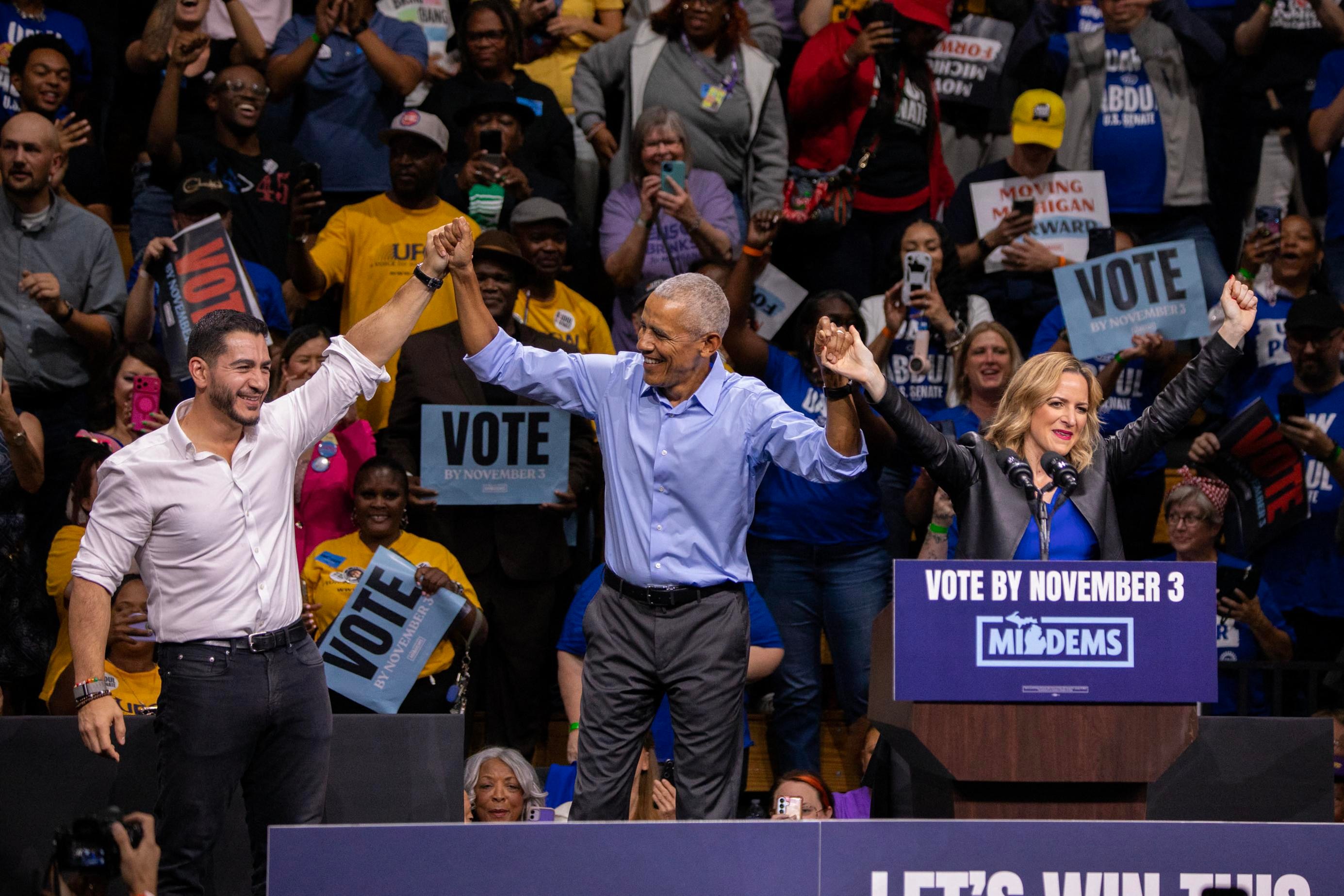
Welcome to The Midterms, Actually. Every week I’ll be writing about two things: one big idea or trend I see forming across the 2026 primaries, and one thing I’m hearing from a voice on the ground. And be sure to check your inboxes this coming Wednesday for a special post-midterms edition! Let’s get into it.
One big idea: Talk of a blue wave makes it less likely
We’re in the thick of what I’ve come to call the silly season of an election cycle. Just days out from November 3 — but weeks into early voting — this is often the time when predictions, analysis, and expectation setting from both parties gets laundered through the media; and is most disconnected from the data. Why? Reasons vary — but I mostly find it an effort to proactively explain the expected results.
For example: in expectation of Democratic Party success, we’re seeing a wave of stories that preemptively explain how that support materialized and what implications it carries. Nate Silver declared on Ezra Klein’s podcast that next Tuesday could mark the “end of the Trump era” if Republicans perform as badly as the polls suggest. Democratic factions are already trying to claim credit for populist messages on corruption and affordability or moderation on cultural issues in red states that they expect to deliver big wins.
Surely, our reporting on America, Actually also speaks to the possibility of this result: We’ve tracked President Donald Trump’s unpopularity from the beginning of the year, when MAGA radio host John Fredericks said the administration’s handling of the Epstein files was ruining its credibility. We’ve gone to Trump’s UFC event in Washington, DC, where young men told us they’d turned on the president after the Iran war. We’ve been to a Speedway in a battleground district in Pennsylvania, where Trump’s own voters said the high price of gas felt like a betrayal from a president who promised to do the opposite.
However, in this post, I wanted to consider one reason why we all could be making a familiar mistake. In the 2016 and 2020 presidential elections there were similar expectations of an anti-Trump wave that never fully materialized, even as he lost that second run. And this isn’t just a criticism of the polls: Some of that overperformance, I suspect, has to do with Republicans’ electoral strategy.
Let me explain: Fear has become Republicans’ one and only source of voter motivation. GOP candidates are not engaging in debates, virtually hiding from the campaign trail, and not really offering a competing vision against their Democratic opponents. They are simply seeking to scare voters about what a Democratic congressional voters may mean, whether it’s the recent freakout about Michigan Sen. Elissa Slotkin’s relatively tame promise about accountability for Trump’s enablers, or the rank Islamophobia we’re seeing deployed against Michigan Senate candidate Abdul El-Sayed, or the endless ads warning candidates will pursue some radical LGBTQ agenda.
Still, just because something is unseemly (or bigoted) doesn’t mean it’s not an effective electoral strategy, and it should be noted that conjuring up fears about women and minority candidates may be the oldest (and most successful) electioneering tactic in the book. And a big part of these attacks is an explicit or implied argument that, whatever you might think of the Republican or Democrat in an individual race, a big Democratic majority would have the power — and feel emboldened by their success — to go way further than you should be comfortable with for years to come.
Here’s what I’m saying: Over the years, I’ve found the No. 1 motivator of Republican voters on Election Day to be the expectation of a Democratic wave. That is, after months of coverage that focuses on Democrats leading the polls and issues with Republican unity and enthusiasm, the exact focus causes Republicans to, eventually, come out on Election Day. It’s not that the polls missed white working-class voters (though they sometimes do) or even that Republican signs of base dissatisfaction were wrong (plenty of them really were unhappy with Trump in 2016). It’s more that, for many GOP voters, dissatisfaction with their own party will usually be overcome by their disdain for their liberal opponents and a nervousness that they might change the country in ways that can’t be reversed later on. The Democratic base is often seeking inspiration; the GOP base is largely motivated by fear.
Here’s what John Fredericks, the radio host, told me for our upcoming episode about the GOP’s “final argument”:
“These fake polls came out over the summer. Democrats are going to win. Democrats are going to win. Trump is down… It was like a fake news, fake poll, full court press that went on for months, that has now motivated MAGA voters out of fear to turn out.”
And to some degree — I believe him. To me, this is a clear reason why Republicans often outperform their low expectations. But it’s also a reason to step away from the takes of electoral silly season, especially with Election Day just around the corner. Voters can consider the issues themselves; there’s no need for constant speculation about the results that overly raises expectations for one side or panics the other.
We already have the scope of information we’ll get: Democrats are well-positioned to take back the House. They’ve expanded the map in the Senate elections and in governor’s races across the country. They’ve done so with a relentless focus on affordability and lowering prices, eschewing the talk of climate change and social issues for priorities that are more tangible to their base.
But that doesn’t mean there’s a cakewalk to a blue wave. And if anything, the expectation of its arrival may make it more hard to accomplish.
What I’m hearing
This week, we spoke with Mikella Schuettler, a Report for America corps member with the Associated Press in Arizona. She’s been covering how federal policy changes to benefits affect different communities, including refugees and other legal immigrants.
You reported on refugees and other legal immigrants losing Medicaid coverage. Who is affected, and what have you heard from families about what losing that coverage means for them?
My reporting focused on people including refugees, victims of human trafficking, and others who were granted legal asylum, pushed from Medicaid as a result of last year’s tax and spending reductions bill that Republicans often refer to as the One Big Beautiful Bill. Coverage has generally not been available to undocumented immigrants, but it’s been standard to offer legal immigrants, including those who are fleeing wars or genocide, healthcare coverage in order to support their entry into the country.
I spoke to a family who entered the US on a T-visa, which is a special visa for victims of human trafficking. Their 17-year-old son got into a car accident five years ago and requires various machines and medications in order to survive, but without Medicaid coverage they won’t be able to pay for almost any of his care. When I spoke to them, they were unsure of how long he would be able to live. His mother told me she believed the Trump administration was attempting to make it so difficult for immigrants, even legal ones, to live in the US that people will self-deport. Though she understands this, she knows her son won’t survive traveling back to Mexico either.
How are people finding out about these changes, and what options do they have when their coverage ends?
In Arizona, people received letters in the mail anywhere from about two months to just days before their coverage was cut. Additionally, if people have somehow missed these letters (perhaps they haven’t updated their addresses), it’s possible they’ll only discover they’ve been cut when they go to receive care. If the state has accurately assessed a person’s immigration status, there is no opportunity to appeal the decision once cut.
In Arizona, unlike many other states, the cuts also impacted some lawfully present children.
I spoke to a single mother whose son has autism and was frustrated because she felt abandoned by the system with no way to appeal. Medicaid pays for a speech pathologist and some additional support after school, which allows her to work in a long-term care home. She received the notification that her son’s coverage was ending in the mail about a week before the deadline. At first, she told me she felt relieved because she knows all her immigration papers are in order. She was shocked to find even though she’s working, paying taxes, and legally entered the country, there was no way to appeal this decision.
In your reporting, are people connecting these changes to decisions in Washington? How, if at all, is that showing up in conversations about the midterms?
None of the people I spoke to can vote in the federal election. However, I’ve spent the last week speaking to voters across Phoenix, and healthcare is a galvanizing topic for both Republicans and Democrats. Over the past few years, federal prosecutors in Arizona have found countless instances of people defrauding the Medicaid system, raking in millions of dollars to run addiction rehabilitation centers that either don’t exist or don’t provide the care they allege. This has really angered a lot of people and soured attitude towards the Medicaid system in general.
At the same time, the stories I’ve heard from people who rely on coverage are indicative of what future cuts could look like. In January, states will implement various work requirements that are projected to force millions of US citizens off Medicaid, requiring them to prove employment before getting coverage again. These cuts coming down the pipeline after the midterms are also a major concern for voters in Arizona, who worry emergency rooms will be overrun by people who aren’t insured.
 Vox is an American news and opinion website owned by Lupa Systems. The website was founded in April 2014 by Ezra Klein, Matt Yglesias, and Melissa Bell as part of Vox Media, and is noted for its concept of explanatory journalism. Vox's media presence also includes a YouTube channel, several podcasts, and a show presented on Netflix. Vox has been described as left-leaning and liberal.
Last updated from