Dan McKeon looked over the data and knew something needed to change.
The superintendent of the K-12 Bug-O-Nay-Ge-Shig School on the Leech Lake Reservation had watched his school’s reading test scores slide during the COVID-19 pandemic. On average, the first class of seniors to graduate after the pandemic scored at a fifth-grade level.
“It kind of created a sense of urgency for us to do something with our reading program,” he said.
A researcher at the University of Minnesota recommended the school try Direct Instruction. Hundreds of studies show the highly structured curriculum gets kids reading fluently using repetition, phonics instruction and drills, but it’s rarely used in schools.
Impressed by the data and demonstrations they witnessed at a national conference, McKeon and his staff decided to make the switch in August 2024, just a couple of weeks ahead of the new school year.
The results so far have been encouraging. After two years using Direct Instruction’s Reading Mastery program, students made close to four years of progress on basic reading skills like sounding out words.
While some teachers remain skeptical of Direction Instruction, they also say it has advantages.
“I have a lot of mixed feelings about it. But I do see the growth, and we do see success with struggling students,” said Ingrid Mesarina Tibbetts, a second grade teacher and a graduate of Bug-O-Nay-Ge-Shig.
‘That was literally perfect!’
Direct Instruction’s presence was easy to see during a visit to the school in May. The school teaches about 180 kids from kindergarten through high school.
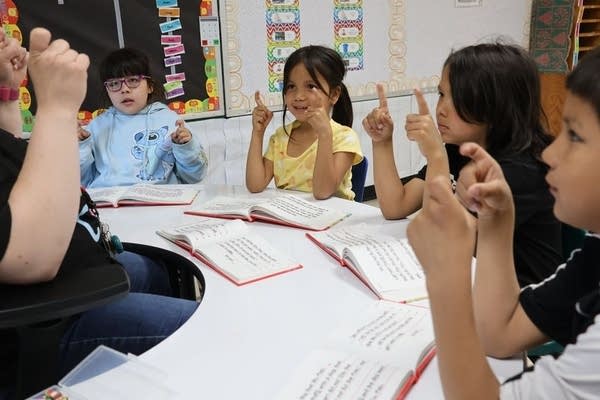
Elementary-age students made their way to reading lessons while “Walking on Sunshine” played over the loudspeakers. Students call it “walk to read” because Direct Instruction groups students for reading lessons by their level, not their grade.
While lower-level groups work on basic skills like reading individual words, more advanced groups work on comprehending longer passages with specialized vocabulary.
Instructor George Jones coached his group through Corrective Reading, a program designed to help students in third grade or higher catch up to grade level. Students took turns reading a passage on extreme climates at high altitudes.
“You guys, that was literally perfect! I loved your pacing, your volume,” Jones called out. Teachers are trained to correct mistakes as soon as they happen, but they are also supposed to incorporate lots of positive reinforcement.

Lessons are designed so that students get lots of practice at an appropriate level of challenge. The material is broken down into small chunks and reviewed until every student has mastered it.
The reading groups are flexible, so that students can move up as they make progress.
Bambi Brown teaches sixth grade and special education classes. She said that flexibility has been key to helping students catch up. “That program really fit our higher elementary students who were some three and four grade levels behind, who are now on grade level.”
Bold ideas, scripted lessons
Direct Instruction was developed in the 1960s by Siegfried Engelmann, an outsider to the world of education. He was working in advertising when an executive from a candy company asked him to find out how many repetitions it took for a child to learn something.
That seemingly simple question captivated him. He began by teaching reading, math and science to his own children and later started an experimental preschool at the University of Illinois. There, he developed Direct Instruction to see how much he could accelerate student progress. He was so successful that he was able to teach his preschoolers basic algebra.
After just a few years, Direct Instruction was included in a massive federal study known as Project Follow Through. From 1968 to 1977, Project Follow Through tested 22 different teaching methods around the country. The goal was to find ways of improving education for kids from low-income families.
In the final evaluation, Direct Instruction came in first place. Educational leaders, though, chafed at the method’s scripts and rigid construction.
Visitors to a Direct Instruction classroom will notice a distinct call-and-response pattern. Teachers ask a question, give students time to formulate their answer, and signal them to respond with a command or a snap. At Bug-O-Nay-Ge-Shig, third grade teacher Priscilla Smith led her students through a list of vocabulary words with the command “Next word. What word?”
“Gigantic,” the students responded in unison.
“Spell gigantic. Get ready.”
“G-I-G-A-N-T-I-C.”
They made their way through a list of words like “continuing,” “powering,” “naughty,” and “racing.”
Today, fewer than 200 schools in the country use Direct Instruction as their main reading program. It’s more commonly used in special education classes or as an intervention for struggling students.

The word-for-word scripts remain the biggest hurdle for many teachers.
While she sees positive responses from kids, “it's still really hard for me being a teacher to be so rigid on script delivery,” said Tibbetts, the second grade teacher at Bug-O-Nay-Ge-Shig.
Some students respond better than others to Direct Instruction, she added. “Some love to practice. They love to show how much they can read. But we do have a few that just really struggle. They don’t like the repetitiveness of it.”
Kim Gibbons, the expert at the U of M’s Center for Applied Research and Educational Improvement who recommended Direct Instruction to Bug-O-Nay-Ge-Shig, saw the program’s structure as an advantage. “I thought it could be a really good match because of the scripted nature and the instructional design of the program.”
Gibbons had worked for a district in Minnesota that went from 20 percent of kids proficient in basic reading skills to almost 80 percent using Direct Instruction in the 2000s. She hoped Bug-O-Nay-Ge-Shig could see similar improvement.
Gibbons pointed to several reasons why Direct Instruction is not very commonly used. Trends in literacy education, low funding, and perceptions that Direct Instruction is not aligned with state standards can all dissuade schools from considering the program.
‘You need to be able to read well’
While the adults might not be completely aligned with Direct Instruction, the data shows student reading skills have improved at Bug-O-Nay-Ge-Shig over the past two years.
“It's exciting to see the kids excited about it,” said Gloria Mitchell, the school's reading coordinator and curriculum director. “You can tell they have more confidence and they're proud of themselves.”
Direct Instruction has created a strong foundation for their school, but ultimately staff hope to mix in other ways of teaching, Mitchell said. “We want students to be able to engage in other ways of learning, especially within our school and the community.”
Bug-O-Nay-Ge-Shig also offers Ojibwe language and seasonal activity classes including spear fishing and harvesting wild rice.
The Leech Lake Band of Ojibwe, Gaa-zagaskwaajimekaag, is a federally recognized tribe.
The school was founded more than 50 years ago when a group of 35 students walked out of the local school system. The school buildings were in declining condition for years until a new building opened in 2018.
Rose Robinson, the school board chair, was one of the original Bug-O-Nay-Ge-Shig teachers. She remembers starting out in a small cabin, relying on the books the students brought with them when they walked out.
“The kids that walked out were very interested in continuing their education,” said Robinson. “They wanted to be in a school, but they wanted to be in a school that supported who they were.”
Transforming the school’s reading program is the first step to providing robust cultural education, McKeon said.
“I think that there's a connection between our kids being confident readers and our kids being passionate about things like learning to speak Ojibwe, learning the history of who they are and the community they come from. But to dive into that world, you need to be able to read well.”
Mathew Holding Eagle III is a reporter with MPR News based in Bemidji, Minn. Olivia Chilkoti is part of the team behind the Sold a Story podcast from APM Reports.
The podcast is out with a new season about the surprising history of one of the most effective — and controversial — teaching methods in American education. Go to your podcast app and follow Sold a Story.
Collected from Minnesota Public Radio News. View original source here.
 Minnesota Public Radio (MPR) is a public radio network for the US state of Minnesota. With its three services, MPR News, YourClassical MPR and The Current, MPR operates a 46-station regional radio network in the upper Midwest.
Last updated from