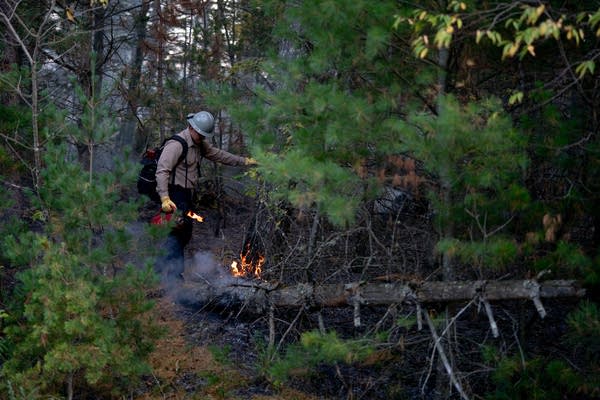
Good fire returned to Minnesota Point in Duluth on Thursday, when the Fond du Lac Band of Lake Superior Chippewa and its partners set a cultural prescribed burn on the narrow strip of land between Lake Superior and the bay.
The day began with a ceremony led by Fond du Lac Band of Lake Superior Chippewa elder Ricky DeFoe. DeFoe began by making a small fire from cedar and birch bark gathered at the point.
“The objective is to connect, reconnect to our Mother Earth,” DeFoe told project leaders along with two dozen tribal and state fire managers gathered for the ceremony.
At DeFoe’s request, fellow Fond du Lac elder Vern Northrup lit the fire, and later used the embers to ignite the burn on Minnesota Point’s 17 acres of woodlands.

The low-intensity fire follows an intense wildfire season in the northeast. Northrup, who spent 25 years fighting wildfire, was there for what he calls the judicious application of fire by fellow firefighters.
“All these different agencies, they’re all doing it for a reason, to manage our environment,” Northrup said. “It needs fire to do that. That’s what’s been missing. That’s why it’s so overgrown. That’s why we have the catastrophic fires we have.”
The burn was a collaboration among the Fond du Lac Band, the city of Duluth, the Minnesota Department of Natural Resources and the U.S. Fish and Wildlife Service. It took place on protected public lands managed by the state, land where Ojibwe tribes in northeast Minnesota exercise treaty rights.
Bazile Panek, an enrolled member of the Red Cliff Band of Lake Superior Chippewa, leads the project, called Returning the Spirit of Good Fire to Minnesota Point. Panek is CEO of Good Sky Guidance, a consulting firm that helps organizations work with tribal nations.
The project is supported by a three-year cooperative agreement with the U.S. Fish and Wildlife Service, and the nonprofit Minnesota Point 50 serves as its fiscal sponsor. Panek says the project wouldn’t be possible without their partnership.
Northrup says fire will help restore blueberry patches and help the old growth red pine regenerate. Before ignition, he stopped in the burn area to point out blueberry plants growing in the shade without fruit.

“Those are decadent plants that have grown for years, but they don’t have the sunlight,” Northrup said. “We’re going to give them more sunlight and give them a shot of nitrogen.”
He says the forest itself needs the same relief.
“We’re going to help it to breathe,” Northrup said.
Northrup worked throughout the day to protect red pine that he and others identified as culturally modified trees, old growth red pine whose sap was collected to make the pitch Ojibwe people used to waterproof their canoes.
“The red pine provided the best, because you could keep coming back to it,” he says.
Valerie Ross, whose Ojibwe name is Zhaawendaagozikwe, helped DeFoe with the ceremony and spoke for the water. She also helped map the old growth red pine as part of her student research at Fond du Lac Tribal and Community College, and she brought her infant daughter to the burn.
“It was just beautiful to walk down the trail and remember being out in the woods looking for samples, and learning about the history, and being an Ojibwe person doing science out there on our own history, and then being able to get results,” Ross said. “It’s a beautiful thing to see.”

Ross says the ceremony that opened the burn matters as much as the fire itself. In her tradition, lighting a fire means asking for help and setting an intention.
“In our way, we believe fire is a spirit,” Ross said. “When we start a fire, it’s like we are asking that spirit to be there. Fire spirits that have been here for thousands of years, help us out. Help us little human beings. We need your help.”
Evan Larson, a professor who studies fire ecology at the University of Wisconsin-Platteville, worked with Ross’ research crew. He says prescribed burns allow people to build a healthy sense of climate resiliency.
“So much of the world right now, if you’re paying attention to environmental issues and challenges, it feels so big and so out of reach and so just heavy. And so, this is an act that we can do,” Larson said.

Larson says a burn like this one makes the land itself more resilient to a changing climate. He says clearing out built-up fuel lowers the risk of severe wildfire, and the forest stores carbon as it recovers. He says the burn also gets people outside and engaged with the land.
“All of these pieces are vital to helping shape a culture that is engaged, that is caring, that loves the land and takes care of the land and recognizes that we have that as not just a role, but maybe even a responsibility,” Larson said.
As fire reached the western edge of the burn area, Duluth firefighter Ben Smith filled water bladders from a Duluth fire rig. Crews use the bladders to put out spot fires before they get too big. Minutes before, flames climbed a small birch.

“With just a little water, a couple of squirts, it goes right out, and it saves the tree,” Smith said. “Our overall goal here is to ecologically restore the area, and if we can put a little effort into saving some of the resources, it matters a lot.”
Elder Vern Northrup spent the afternoon tending the red pine trees and educating people.
“Everything you see around here is fire dependent. It’s always seen fire, and it’s just been removed for so long,” he says. “We’re going to change that. Yep, we’re going to change that.”
Northrup says he will return to the point in the future to pick blueberries.
“I’m going to be back here, and I’m going to bring my grandchildren back here.”
Collected from Minnesota Public Radio News. View original source here.
 Minnesota Public Radio (MPR) is a public radio network for the US state of Minnesota. With its three services, MPR News, YourClassical MPR and The Current, MPR operates a 46-station regional radio network in the upper Midwest.
Last updated from
Minnesota Public Radio (MPR) is a public radio network for the US state of Minnesota. With its three services, MPR News, YourClassical MPR and The Current, MPR operates a 46-station regional radio network in the upper Midwest.
Last updated from