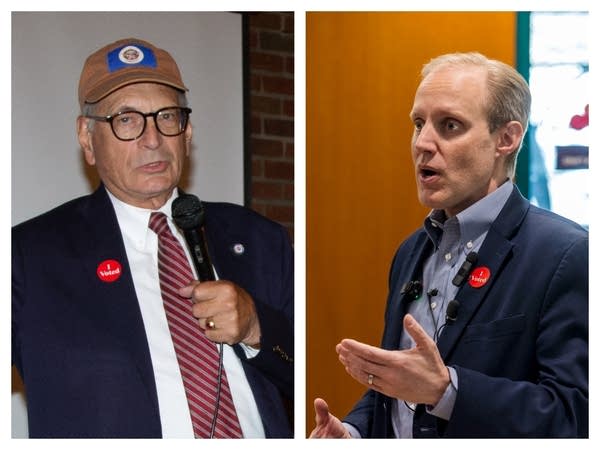
The Minnesota Secretary of State’s race isn’t often top of mind for voters, but the Trump administration’s focus on the state’s elections has renewed attention on what otherwise can be a relatively sleepy race.
Secretary of State Steve Simon, a DFLer, is seeking a fourth term as Republican Tad Jude, Libertarian candidate Chip Tangen and the Green Party’s Seth Kuhl-Stennes try to unseat him. Candidates for the office are grappling with something new — how to approach the Secretary of State’s relationship with the Department of Justice.
Elections run by Minnesota and other blue states have been harshly criticized by the Trump administration. Last month, the Justice Department announced ten people had been indicted for voter fraud, mostly in Minnesota’s 2022 and 2024 general elections, and one in this year’s August primary. Across those three elections, nearly seven million votes were cast.
Last year, when Simon and other secretaries of state refused to hand over private information on their state’s voter rolls, the Justice Department filed lawsuits against them, arguing that it needed the information to ensure ineligible voters are removed from voter rolls. Simon called the lawsuit “a fishing expedition” and a federal judge ultimately dismissed the lawsuit in Minnesota. More than 20 other states have faced similar litigation.
“The action is unprecedented,” said Kathryn Pearson, a political science professor at the University of Minnesota. “The federal government has never had a national voter file, and so this has put secretaries of state into a new position of having to respond to requests from the Department of Justice.”
During President Donald Trump’s second term, Simon has wrestled with the administration over access to that confidential voter data while also defending Minnesota’s election integrity and the state’s access to mail-in voting. Simon said Minnesotans want someone in the Secretary of State’s office with experience standing up to Trump.
“We need someone who will stand up to any and all who will unlawfully attempt to interfere with the freedom to vote,” Simon said. “That means my own party. That means the current White House.”
But his Republican challenger, former Minnesota lawmaker and district court judge Tad Jude, said Simon has politicized the office. If elected, Jude said he would start by having a working relationship with the Justice Department.
“I would certainly want to ensure that the privacy of Minnesotans is safeguarded,” Jude said, when asked whether he would hand the federal government private information on state voter rolls. “I expect to have, at least initially, a good working relationship, and if it gets to the point where there’s a breakdown, I’d hold them accountable.”
On Wednesday, Minnesota’s Republican congressional delegation sent a letter to Simon and Gov. Tim Walz calling for increased election security.
Chip Tangen, who used to be active in the state GOP party but now identifies as a Libertarian, said he’s running to raise awareness for third-party candidates and doesn’t think the Secretary of State’s office should be partisan. Seth Kuhl-Stennes, a union organizer, is also running as a member of the Green Party.
“I don’t expect that we will see independents elected as Secretary of State,” Tangen said. “When the chief election officer happens to be a partisan who plays for one of the two teams, it’s hard for that person, regardless of their intent, to not give the appearance of bias in their decisions.”
Photo ID at the polls?
Jude supports requiring Minnesota voters to have a photo ID in order to cast their ballots. Current law requires Minnesotans to show proof of residence when registering to vote. Thirty-six states require voters to show proof of identification at the polls.
“I want to ensure that only legal U.S. citizens are voting,” Jude said. “If you have people who are not authorized to vote voting in our system, it’s robbing someone who’s a legitimate voter of their vote.”

Advocates for voter ID laws say it would strengthen election integrity, but opponents say the laws could become a barrier to voting.
“When a mini version of that bill was implemented in the state of Kansas a few years ago, before a federal judge invalidated it, they actually held an election under that law. And when they did, 31,000 eligible Kansans, born, raised, voting for years or decades, were turned away and shut out of the election,” Simon said. “Is it worth potentially shutting out and disenfranchising tens of thousands of Minnesotans to catch a few handfuls? That I think is the question and I think the answer is no in that particular case.”
Aside from elections and voter registration, the Secretary of State’s office also oversees the state’s business filling system. Like all other races this election season in Minnesota, the Secretary of State’s race is no stranger to conversations about fraud. Jude wants the office to take a more preemptive approach to combatting fraud in the state's social service programs.
He suggested the creation of a business integrity unit, “which would be a dedicated team within the office to review registration data for fraud indicators and refer red flags to investigators like the BCA or the FBI before fraudulent dollars are billed.”
Simon said the Secretary of State’s office already shares business filing data with the Bureau of Criminal Apprehension.
“We’re not criminal investigators,” Simon said. “We’re giving them the data and providing them with information so that they, the experts, can connect the dots.”
Collected from Minnesota Public Radio News. View original source here.
 Minnesota Public Radio (MPR) is a public radio network for the US state of Minnesota. With its three services, MPR News, YourClassical MPR and The Current, MPR operates a 46-station regional radio network in the upper Midwest.
Last updated from
Minnesota Public Radio (MPR) is a public radio network for the US state of Minnesota. With its three services, MPR News, YourClassical MPR and The Current, MPR operates a 46-station regional radio network in the upper Midwest.
Last updated from