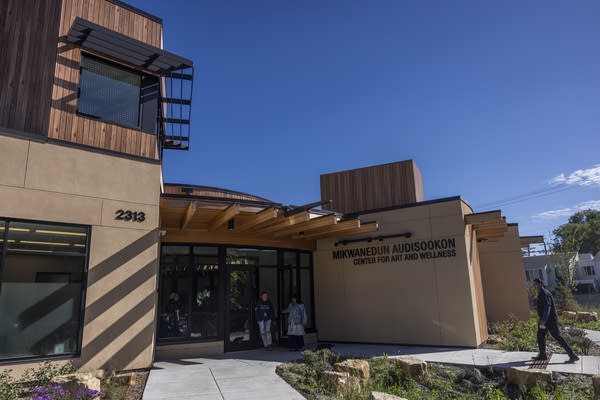
Indigenous Peoples Task Force celebrated the opening of its new center for art and wellness in south Minneapolis Friday afternoon. The building is called Mikwanedun Audisookon Center, which means “remember our teachings” in the Ojibwe language.
The $12 million project began over a decade ago, says executive director Sharon Day. The organization needed more space as its program offerings expanded. The space brings the organization's health and environment education, as well as arts and theater programming, under one roof with green spaces and a black box theater.
“Now we can continue to do our work in an environment that's healthy, makes people feel good to be there, and we have a beautiful place for the community. So, we're just beginning,” Day said.

Located in the Phillips neighborhood and on an adjacent lot next to Indigenous Peoples Task Force, the building is roughly 12,000 square feet with two floors. Day says that, in addition to programming needs, the building will serve multiple purposes — from providing community meals to healing initiatives with its commercial kitchen, meditation room and open workspaces for the community.
Sir Curtis Kirby III, director of the youth theater program, looks forward to having a space to do longer performance runs.
“We've been in classrooms, churches, hallways, outside, inside — and so we never really had a permanent home,” Kirby said. “There's things that we can't do when we're in those spaces, like smudge or practice our traditional ways. And so, I'm really grateful that we can be in here.”
The task force began raising funds in 2014, with a quarter of its funding coming from individual donors and foundations. In 2022, Hennepin County invested $750,000 through its Community Investment Initiative. Funding also came from the state of Minnesota and the city of Minneapolis.

“If I wanted to build just a cement rectangular building, it probably could have done it a lot sooner,” Day said, referring to the center’s design and the materials used in its construction. The organization utilized compressed earth blocks, which are eco-friendly and made from soil, clay and sand. The blocks were used in the front half of the building and in the theater.
“One thing was raising the money, and then also convincing funders that the compressed earth block would work,” she said. In the winter, compressed earth blocks absorb heat and release it. During the summer, at night, they absorb cool air and release it during the day.
Indigenous Peoples Task Force began to offer training in green technology during the construction of Mikwanedun Audisookon Center. Day says there were opportunities for Indigenous young adults to help make the compressed earth blocks. Those opportunities are expected to continue in hopes of improving career outcomes and living standards for the local Indigenous community.

For Day, she says the project was very personal. She wanted to see its construction through from start to finish.
“I'm happy to have achieved creating a beautiful space for our staff, a theater for our youth, a beautiful dining area for people who are coming in off the street to be able to sit down and have a hot meal,” Day said.
Chandra Colvin covers Native American communities in Minnesota for MPR News via Report for America, a national service program that places journalists into local newsrooms to report on under-covered issues and communities.
Collected from Minnesota Public Radio News. View original source here.
 Minnesota Public Radio (MPR) is a public radio network for the US state of Minnesota. With its three services, MPR News, YourClassical MPR and The Current, MPR operates a 46-station regional radio network in the upper Midwest.
Last updated from
Minnesota Public Radio (MPR) is a public radio network for the US state of Minnesota. With its three services, MPR News, YourClassical MPR and The Current, MPR operates a 46-station regional radio network in the upper Midwest.
Last updated from